Many parents wait a long time before asking about assessment.
Not because they do not care. Often, it is because the situation is confusing.
A child may be bright in conversation but careless in homework. They may understand a lesson today but forget it tomorrow. They may sit for hours with books open but still complete very little. They may be called lazy, careless, stubborn, distracted, or immature.
At home, parents may start wondering:
- “Is my child not trying hard enough?”
- “Is this an attention issue?”
- “Could it be a learning difficulty?”
- “Is it stress, anxiety, or low confidence?”
- “Should we wait and see, or should we check properly?”
These are very common questions. A psychological assessment can help when the same concerns keep repeating and ordinary advice is no longer enough.

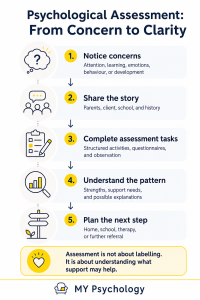
Caption: When concerns keep repeating across home, school, or daily routines, assessment can help organise the information and identify what may need support.
When “Lazy” May Not Be The Full Story
Children are sometimes described as lazy when adults can see potential, but the child’s performance does not match that potential.
For example, a child may speak well but struggle to write. They may know the answer verbally but freeze during written work. They may be able to focus on games or videos but cannot stay with schoolwork. They may look like they are not listening, even when they are trying.
This does not automatically mean the child has ADHD, a learning difficulty, or any specific diagnosis. But it does mean the pattern deserves a more careful look.
The useful question is not “Is my child lazy?” The more useful question is: “What is making this task so difficult for my child?”
Assessment Looks For Patterns, Not One-Off Mistakes
A psychological assessment does not rely on one complaint, one bad exam result, or one difficult week. The psychologist looks for patterns.
Some patterns may suggest attention or executive-function difficulties. Some may suggest learning-related challenges. Some may point to emotional stress, low confidence, sleep problems, family changes, school pressure, or a mismatch between the child’s current support and their actual needs.
This is why assessment usually includes more than one source of information. The psychologist may consider parent concerns, school feedback, developmental history, questionnaires, observations, and structured tasks.

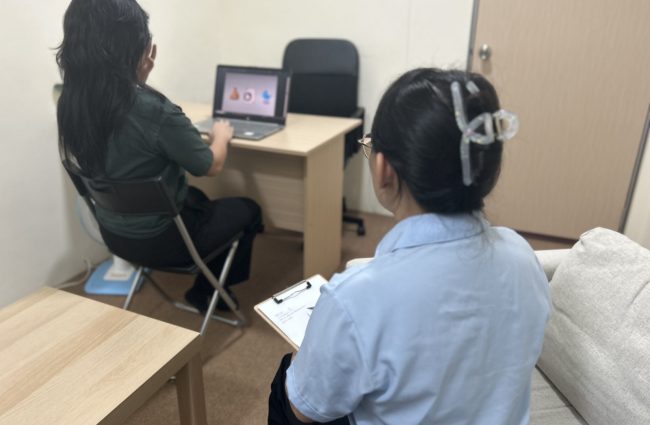
Caption: Some structured tasks help the psychologist observe attention, planning, speed, persistence, and how the child responds to demands.
Attention Difficulties Can Look Different In Different Children
Attention difficulties are not always obvious. Some children are visibly restless and active. Others are quiet, dreamy, slow to start, easily overwhelmed, or mentally tired after short periods of work.
Some children can focus very well on things they enjoy, but struggle with tasks that are repetitive, effortful, written, timed, or multi-step. This can be confusing for parents because it may look selective.
Assessment can help explore whether attention is part of the picture, and whether the difficulty appears mainly in focus, impulse control, working memory, planning, processing speed, emotional regulation, or consistency.

Caption: Assessment can help clarify whether a child is struggling with learning, attention, processing speed, memory, or another area that affects daily performance.
Learning Issues Are Often Misunderstood
A child with a learning difficulty may still be intelligent. This is important.
Learning difficulties do not mean a child cannot learn. They may mean the child needs information presented differently, more time, more repetition, targeted intervention, or support in specific academic skills such as reading, spelling, writing, comprehension, or mathematics.
Without assessment, the child may keep receiving the wrong message: “Try harder.” But if the underlying issue is not effort, more pressure may increase frustration without solving the problem.
A clearer understanding can help parents and teachers respond more accurately.

Caption: Computer-based attention tasks may be used as one part of the assessment process. They do not stand alone, but they can add useful information when interpreted with the full clinical picture.
Assessment Is Not About Blaming The Child Or The Parent
Many families delay assessment because they worry the result will become a label. This fear is understandable.
But a helpful assessment should not be used to blame the child, blame the parent, or reduce a person to a diagnosis. The goal is to understand what support may be needed.
For some families, assessment confirms that no diagnosis is appropriate, but still provides useful recommendations. For others, it may clarify ADHD, a learning difficulty, autism-related support needs, emotional concerns, or other factors affecting daily functioning.
Either way, the value is in having a clearer map.
When It May Be Time To Consider An Assessment
You may consider a psychological assessment when:
- The same concerns keep appearing despite reminders, tuition, or repeated practice.
- The child’s effort seems high, but the results remain inconsistent.
- Teachers raise concerns about attention, learning, behaviour, or emotional regulation.
- Homework, revision, or school preparation causes frequent conflict at home.
- The child starts saying things like “I am stupid”, “I cannot do it”, or “I hate school”.
- Parents feel unsure whether the concern is attention, learning, emotion, motivation, or development.
You do not need to wait until the problem becomes severe. Sometimes, assessment is most useful when it helps a family intervene earlier and more accurately.
What Parents Can Expect To Gain
A good assessment should help parents move from guessing to understanding.
It may help clarify:
- What the child is finding difficult
- What the child may be doing well
- Whether further intervention or referral is needed
- What parents and teachers can adjust
- Whether school support or accommodations may be useful
- What next step is most practical
For many families, this reduces tension. When the adults understand the child more accurately, support can become less blaming and more targeted.
Final Thought
If your child keeps struggling, it does not automatically mean something is “wrong”. But it may mean that the current explanation is incomplete.
Assessment can help answer the question behind many family worries: “What are we actually dealing with, and what should we do next?”
Unsure whether your child needs an assessment?
You can contact MY Psychology and describe the concerns you are seeing. We can help you consider whether an assessment may be suitable, and what type of assessment may be relevant.