
Child & family assessment
Child Psychological Assessment
Understand the pattern behind your child’s struggle.
When learning, attention, emotions, behaviour, or social development becomes difficult to understand, assessment can bring together what happens at home, at school, and during child sessions.
 Home + school + child sessions
Start with the question
What are you trying to understand?
A child may struggle in more than one way. The first step is to identify the patterns that are affecting daily life, learning, relationships, or confidence.
Learning and thinking
- Falling behind despite effort
- Difficulty with reading, writing, spelling, or maths
- Trouble remembering or applying concepts
Attention and executive functioning
- Easily distracted or forgetful
- Struggles to organise, plan, or begin tasks
- Difficulty following through or managing time
Emotional and behavioural regulation
- Big emotions or frequent meltdowns
- Impulsive, avoidant, or defiant behaviour
- Anxiety, worries, or reduced confidence
Developmental, adaptive, and social functioning
- Slower to learn everyday skills or manage routines independently
- Difficulty making or keeping friendships
- Social communication differences
- Differences in language, play, routines, or flexibility
Assessment looks across settings
Multiple perspectives create a clearer whole-child picture.
One test score or one difficult day rarely tells the full story. The psychologist integrates information from the people and settings that know your child differently.
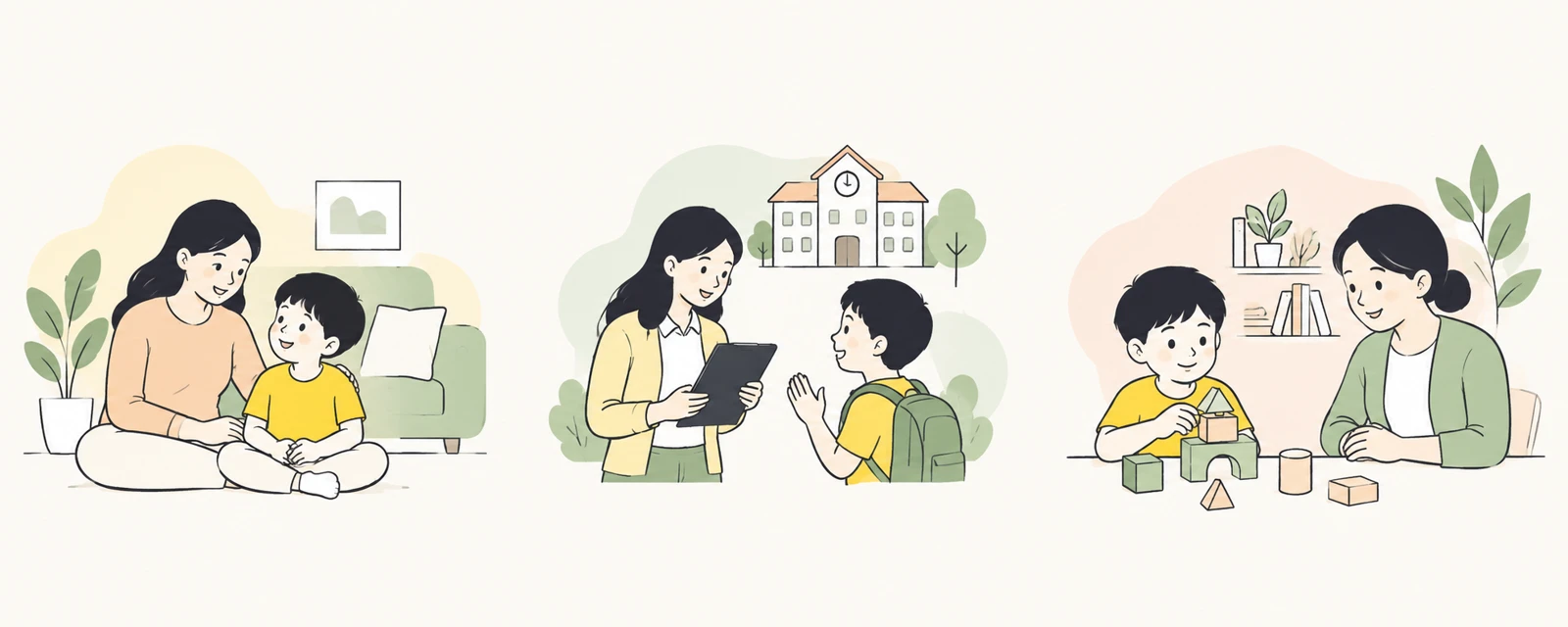
- Emotions and behaviour
- Routines and transitions
- Communication
- Daily functioning
- Learning and progress
- Attention and instructions
- Friendships
- Classroom participation
- Age-appropriate structured tasks
- Interviews or questionnaires
- Observation and interaction
- Strengths and problem-solving
Choose the question, not the label
Which assessment may fit?
You do not need to know the answer before contacting us. An initial consultation helps clarify the main question and whether a focused or broader assessment is more suitable.
ADHD assessment
Attention and self-regulation?
ExploreAutism assessment
Communication, sensory needs and routines?
ExploreLearning difficulties assessment
Reading, writing, spelling or maths?
ExploreBroader child assessment
Several overlapping concerns?
ExploreView the full assessment comparison
| Assessment pathway | Often considered when | The question it helps answer | What the assessment may help clarify |
|---|---|---|---|
| ADHD assessment | There are ongoing concerns about attention, hyperactivity, impulsivity, organisation, or task completion. | Are the attention difficulties consistent with ADHD, or could another factor better explain them? | May clarify patterns in attention and self-regulation and inform practical recommendations for home and school, depending on the findings and assessment scope. |
| Autism assessment | There are questions about social communication, interaction, sensory experiences, routines, or restricted interests. | Is the child’s developmental profile consistent with autism, and what support would help? | May provide a strengths-and-needs profile and inform recommendations for communication, learning, and daily life, depending on the findings and assessment scope. |
| Learning difficulties assessment | The child struggles with reading, writing, spelling, maths, memory, or academic progress despite support. | Why is learning difficult, and what specific educational support may be needed? | May provide a clearer learning profile and inform recommendations for intervention or school support, depending on the findings and assessment scope. |
| Broader child assessment | Concerns overlap across learning, attention, emotions, behaviour, cognitive development, everyday/adaptive functioning, or relationships. | What is contributing to the overall pattern, and should cognitive development or everyday/adaptive skills be explored further? | May provide a more integrated understanding and inform coordinated recommendations for the child’s next steps. |
Assessment does not automatically lead to a diagnosis. Its purpose is to answer a defined question and guide appropriate next steps. When clinically appropriate, a broader child assessment may consider both intellectual functioning and adaptive functioning—the conceptual, social, and practical skills used in everyday life—alongside the child’s developmental history and other relevant factors. Intellectual disability is not determined by an IQ score alone.
A child-friendly, evidence-informed process
What happens during a child psychological assessment?
The exact tools and number of sessions depend on the referral question, the child’s age, and the information already available. You will receive the recommended plan before testing begins.
Initial consultation
We listen to your concerns, review background information, and clarify the question the assessment should answer.
Assessment plan and written quotation
The psychologist recommends the scope, tools, sessions, expected timeline, and provides a written quotation before testing.
Testing and information gathering
Child-friendly tasks are combined with relevant parent, teacher, school, and developmental information.
Scoring, interpretation and written report
The psychologist scores and integrates the evidence. A written report is prepared when included in the agreed scope.
Feedback, recommendations and next steps
We explain the findings clearly and discuss realistic next steps for home, school, and further support.
Useful beyond the assessment room
What parents receive
A clearer understanding
A joined-up explanation of the child’s strengths, needs, and the patterns affecting daily life.
A written report, where applicable
A structured record of the findings, interpretation, and recommendations in accessible language.
Practical recommendations, where applicable
Depending on the findings and agreed assessment scope, recommendations may cover home, school, intervention, further observation, or referral to another professional.
Who conducts the assessment? Assessments are conducted by qualified clinical psychologists. The psychologist and assessment scope are matched to the client’s age, concerns and referral question. Meet our clinical psychologists.

Before your appointment
Plan your visit with confidence
See our actual consultation rooms, MRT walking directions, maps, opening hours and what to expect when you arrive.
Plan Your VisitBefore you decide
Frequently asked questions
Will the assessment label my child?
The purpose is to understand the child, not reduce them to a label. Diagnostic clarification may be discussed when relevant, but findings should always be explained alongside strengths, needs, and practical support.
Is the assessment painful or invasive?
Psychological assessment is generally non-invasive. It usually involves conversation, age-appropriate activities, structured tasks, questionnaires, and observation. The psychologist will explain the planned process and adapt the approach where clinically appropriate. If medical, hearing, vision, language, or other developmental questions require additional evaluation, referral to another qualified professional may be recommended.
How long does the assessment take?
The timeline varies according to the assessment question, tools required, number of sessions, and whether school information is needed. The expected process and timing will be explained after the initial consultation.
Will this confirm a diagnosis?
Not every assessment leads to a diagnosis. Where diagnostic clarification is appropriate, the psychologist considers multiple sources of information and explains both the evidence and any limitations.
What if my child is shy, restless, or does not cooperate?
This is common. Child psychologists are trained to work with different communication styles, attention needs, anxiety, and comfort levels. The pace and approach can be adapted where clinically appropriate.
Can I ask first before deciding?
Yes. If you are unsure whether assessment is needed, an initial consultation can help clarify the concern, possible options, expected fees, and whether observation or another form of support may be more suitable.
Ready to understand the whole picture?
Start with an initial consultation and decide the next step with greater clarity.
This page provides general information about child psychological assessment and does not replace an individual clinical consultation. MY Psychology is not an emergency or crisis service. If your child is at immediate risk of harm, or there is an urgent safety concern, please contact local emergency services or go to the nearest hospital emergency department.
Clinical references: WHO — Mental disorders; AAIDD — Adaptive Behavior; CDC — Developmental Monitoring and Screening.